27 November 2024
- Miren Estensoro and Claudia Icaran have participated in various international events to deepen their understanding of collaborative governance as a key tool to address the challenges faced by urban environments.
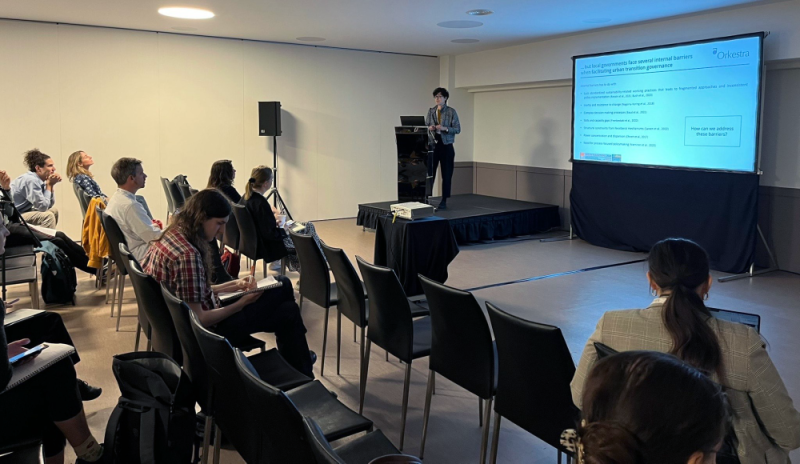
Miren Estensoro, senior researcher at Orkestra, participated in the Urban Transitions 2024 Congress, which brings together experts from different disciplines to address the challenges of sustainable urban development, ranging from urban planning and public health to environmental justice and governance.
In her presentation, entitled Facilitating Urban Transition Governance: Lessons Learnt from Action Research in Basque Cities, she shared key findings derived from action research projects developed by Orkestra, such as Bilbao Next Lab and the collaboration with the Center for Environmental Studies of Vitoria-Gasteiz.
These projects are part of the research line on urban competitiveness being promoted by the Institute and contribute to exploring new approaches to overcome internal barriers to collaboration in local governments, fostering more participatory and horizontal governance dynamics.
Action research: transformative knowledge “from within”
The literature on urban transitions suggests that governance is a key issue in dealing with the complexity of our cities, and that this governance requires the involvement of different urban and territorial actors in processes of learning, negotiation, and experimentation to co-create solutions.
One of the key messages of Estensoro's presentation was the capacity of action research to generate knowledge “from within”, facilitating the implementation of sustainable solutions: “Collaborative governance is essential to address the complexity of urban transitions, and local governments play a fundamental role as facilitators. However, they face internal barriers that limit their ability to engage different actors in processes of learning, negotiation, and experimentation.”
These internal barriers are, precisely, the subject of Orkestra's research in the field. Among the most relevant learnings in this area, the researcher emphasized the need to build facilitation capacities in policymakers, including both technical staff, managers and politicians. This transformation also requires establishing more egalitarian relationships within local governments and with external agents. Regarding researchers, Estensoro affirmed that beyond acting as experts or providing recommendations, they can also actively contribute to building collaborative governance by working on process design and capacity building.
Collaborative governance, key to addressing urban challenges
In recent months, Orkestra has participated in various events to share its learnings in the field of collaborative governance in urban settings.
On one hand, predoctoral researcher Claudia Icaran participated in the Researchers as Agents of Regional Change conference of the Regional Studies Association in Cambridge with a presentation titled Institutional Socialization and Collaborative Governance.
On the other hand, Miren Estensoro share learnings on the design and implementation of collaborative governance to boost the competitiveness of the Advanced Services sector in Bilbao in the Eurocities Economic Development Forum.
Orkestra's participation in these events reinforces the institute's commitment to collaborative governance as a key tool to address the challenges faced by urban environments. The research carried out in Bilbao Next Lab and other initiatives has laid the foundations for proposing practical solutions that contribute to improving competitiveness and wellbeing in the Basque Country.