23 January 2025
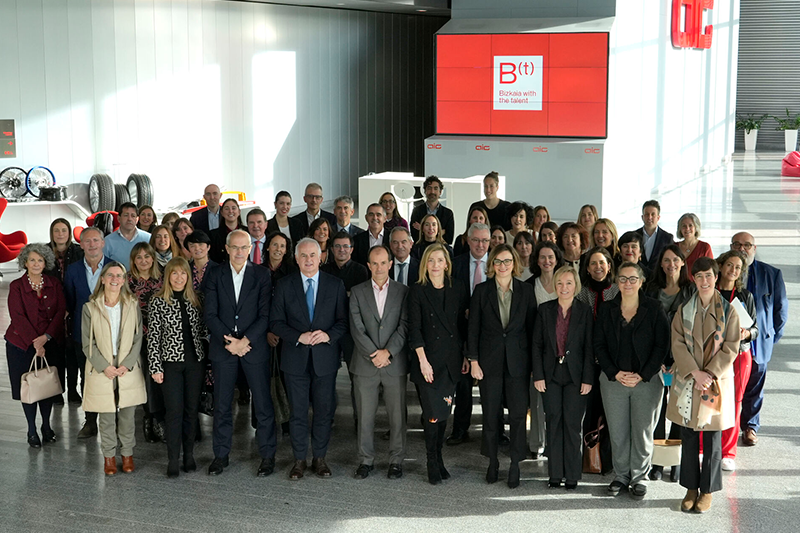
Since 2022, the Department of Economic Promotion of the Provincial Council of Bizkaia with the support of Bizkaia Talent and Orkestra-Basque Institute of Competitiveness, has been developing the “Bizkaia with the Talent” initiative, an ecosystem to address the shortage of STEM talent in Bizkaia. Solving the talent shortage is a key challenge to ensure competitiveness at the service of the wellbeing of the territory.
Orkestra is the research partner of the initiative and, as such, has provided the knowledge and methodological framework for the development of the process. Recently, the research team, consisting of Sofia Zhukova, Juan Gamboa and Edurne Magro, has published a report describing the process of building an ecosystem to address the shortage of STEM talent in Bizkaia.
The report begins with a theoretical analysis of the dimensions involved in territorial talent policies, with particular attention to STEM talent, where the figure of the ecosystem plays a fundamental role in addressing complex challenges such as the talent shortage. It then describes the process carried out in the historical territory of Bizkaia. It concludes with lessons learned from the development of the ecosystem, reflecting on the key elements of such an approach and the challenges for its sustainability over time.
The process documented in the report highlights the importance of the following phases in the construction of the ecosystem: (1) initial diagnosis of the talent situation in Bizkaia and mapping of the key actors in the territory, (2) qualitative comparison of the diagnosis with the key actors to identify talent challenges and specific actions to address them, (3) generation of a decalogue of commitments for action on talent challenges, (4) design and implementation of a governance strategy and working groups for the development of collaborative and innovative projects that represent a turning point compared to what has been done so far.
The process was launched with the consolidation of an ecosystem made up of 36 key agents in the territory, including companies, business associations, clusters, universities, associations of vocational training centres and foundations, among others. Using a collaborative governance model, these agents are already working on 13 projects, and another 6 are in the design phase. All the projects fall into at least one of the four main dimensions of action on the talent challenge: discovering; raising awareness and training; developing and linking; and attracting and creating loyalty.
The report concludes by identifying the key lessons learned in the process of building and developing a STEM talent ecosystem, among which the following stand out:
- Creating objectives, a mission, and a vision collaboratively for promoting STEM talent within the ecosystem, seeking a comprehensive approach to foster such talent.
- Incorporating the key agents involved in attracting, developing, and linking talent, with the goal of generating a multiplier effect for the initiatives within the ecosystem.
- Establishing a collaborative governance model to facilitate the initiatives of agents within the ecosystem for the co-creation of projects that have an impact on the challenges identified.
- Developing incentives for stakeholders to participate in the initiative and for there to be a positive perceived value for stakeholders to be part of the STEM talent ecosystem.
- Having leadership that facilitates a balance between the participation of the agents in the ecosystem and its effectiveness.
- Promoting open communication between projects and dimensions of the ecosystem, with spaces for contrast and synergies between different initiatives and projects.