8 October 2026
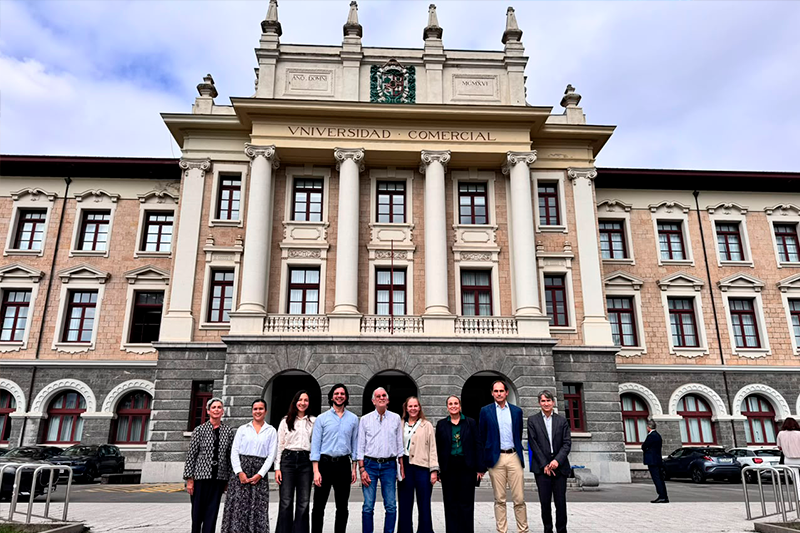
© Image: Delegation of Colombia’s Atlántico Department
- Led by Governor Eduardo Ignacio Verano de la Rosa, the delegation learned about the Institute’s mission and organisational model.
-
Mercedes Oleaga, Stephanía Mosquera and Yazari Agudelo presented several projects developed by Orkestra in collaboration with public institutions and other territorial stakeholders to the delegation.
Last Friday, Orkestra welcomed a delegation from Colombia’s Atlántico Department. The delegation was led by Governor Eduardo Ignacio Verano de la Rosa and also comprised Liliana Borrero, First Social Manager of the Atlántico Department; Cecilia Arango, Secretary of Planning; and Arturo García Sandoval, International Affairs Manager. Located in Colombia’s Caribbean region, with Barranquilla as its capital, Atlántico is one of the country’s 32 departments. As a territorial entity, it is responsible for areas such as territorial planning, economic and social development, and environmental management.
The meeting, coordinated by the Basque Government’s Department of External Action, provided an opportunity to share Orkestra’s mission, organisational structure, and way of working, as well as its main research areas and projects developed with public institutions and other territorial stakeholders. Mikel Larreina, Vice-Dean for International Relations at Deusto Business School, also took part in the meeting on behalf of the University of Deusto.
During the visit, Mercedes Oleaga, Stephanía Mosquera and Yazari Agudelo explained Orkestra’s role as a knowledge-generation institute oriented towards action. Its mission is to contribute to improving competitiveness and wellbeing in the Basque Country through research. Orkestra's model is based on developing research projects with stakeholders who have the capacity to address the territory's challenges.
The delegation also learned about some of the Institute’s key research areas, including its work on the energy and climate transition.
In this context, they were introduced to the energy and climate budgeting project, which is being developed in collaboration with Ihobe. This project aims to identify and quantify the proportion of public spending that contributes to mitigation, adaptation, and the energy transition. It also seeks to develop a shared approach to monitoring this spending. The delegation also learned about research into the social acceptance of renewable energy projects, conducted in partnership with the Basque Energy Cluster (EVE). This research addresses the need to balance the deployment of renewable energy with the requirements and expectations of local communities.
The delegation was also informed about the observatories developed by Orkestra to monitor the competitive performance of territories, conduct diagnostics and support decision-making. These include the Regional Competitiveness Observatory, which compares the performance of over 200 European regions, the Vocational Education and Training Observatory in Spain, and the Basque Hidden Champions Observatory.
This meeting is part of Orkestra’s internationalisation strategy, and demonstrates the Institute’s commitment to sharing the Basque experience as a leading example in international debates on competitiveness and territorial development.