10 October 2018
- Basque companies today are more dependent than ever on the international context.
- Their competitiveness will not only be determined by business strategies, but also by support from agents within the territory.
- Euskadi’s business future will entail adapting to changes deriving from digitalisation and sustainability.
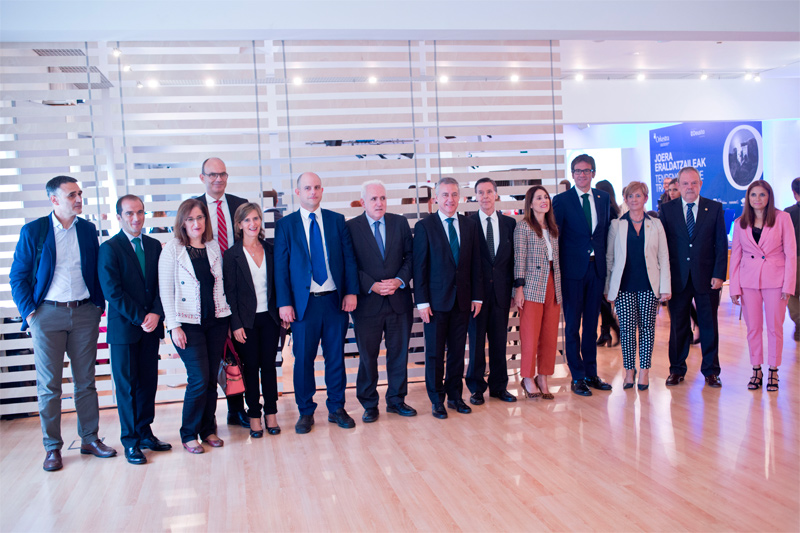
Active listening and analysis of the milieu are considered the keys to ensuring business competitiveness in the future. This has been one of the main arguments of the “Transforming trends” conference, organised by Orkestra within the presentation framework of the 2018 Report on Competitiveness in the Basque Country. (Access the video about the event)
Over 150 well-known personages from the world of politics and business met today at the Artium Museum in Vitoria-Gasteiz at an event during which attention was drawn to the need to focus more than ever on the global and territorial context, in order to deal with the competitive challenges that will be faced in the near future.
Along these lines, the Lehendakari (Basque President) Iñigo Urkullu, who gave the inaugural speech at the conference, expressed his commitment to fostering those policies geared towards socio-economic wealth creation and top quality employment – steps which in Urkullu’s words “will always involve the search for social equilibrium”.
The Report on Competitiveness in the Basque Country, which was presented today to society, concludes precisely by saying that this equilibrium is being achieved by avoiding the kind of economic and social duality that might have occurred after the crisis was left behind, according to what was stated by that work a few years ago.
Notwithstanding this, the economic downturn and structural problems evident in the European economy - on which the Basque economy depends- mean it is more necessary than ever for both companies and institutions to be aware of the external context. Christian Ketels, Chief Economist of The Boston Consulting Group, who analysed how major trends are going to affect Euskadi in his speech, recommended that companies from this territory should undertake diagnoses of the situation, and be prepared to be resilient in terms of their organisational structure. Furthermore, he pointed out that it is now more important than ever to “work by linking the business model to the territory”.
The speech by Ketels served as a starting point for the subsequent debate in which the following took part: Iñigo Ansola, general manager of EVE, Mari Paz Robina, director of Michelin, Iñaki Garmendia, managing director of Ega Master, and Josu Ugarte, Industry Vice-Chairperson of Schneider Electric.
In line with the recommendations made by Ketels, Josu Ugarte drew attention to the fact that, “apart from the risk attached to mergers and takeovers, new business models – i.e. the way in which the company’s enhancement is monetized - will be one of the main future challenges”. Ugarte pointed out that being prepared for new new scenarios means “developing corporate technological capacities via the ecosystem (technology centres, partners) and the direct involvement of the CEO”.
Digitalisation was also the main argument used in the speech given by Mari Paz Robina, who maintained that, apart from helping to incorporate improvements in products, companies need to take advantage of the opportunities that new technologies provide when optimising the business model.
For his part, Iñaki Garmendia, stressed the fact that, in view of uncertainties within the international context, companies need to be brave, “set out objectives and pave the way”.
Lastly, Iñigo Ansola highlighted the contribution being made by the Basque energy sector to competitiveness within the territory and the internationalisation of the business fabric - “not only by leadership of large conglomerates such as Iberdrola and Siemens-Gamesa, but also by value chain companies that make up the energy company network in the country and have been positioning their products and services at an extremely high level around the world for years now”. Ansola stressed the fact that the key is to work and reach agreements which may help to deal with the future challenges that could arise in this sphere of activity in such a way that companies from the sector may continue contributing towards the Basque economy
Competitiveness Observatory
The conference also served as a framework for the presentation of the Competitiveness Observatory. This is a platform developed by the Orkestra-Basque Institute of Competitiveness team which makes public the latest data from the main indicators of competitiveness available for public consultation. This tool, which was today presented by Mari Jose Aranguren, director of Orkestra, has been set up with the aim of “lending support to to all those who work towards the socio-economic improvement of our territory”. It gathers together information from the main available sources of data and works on it with a view to providing the user with the chance to measure and contrast that data in real time with other regions and countries.
In the course of the Observatory’s presentation, Aranguren drew attention to the work undertaken by Orkestra towards improving competitiveness in saying that “beyond providing the tools required and generating capacities to ensure that every agent conducts competitiveness diagnoses within their area, we are helping governments, business and other agents to tackle the challenges attached to competitiveness that we identify in our diagnoses, with a view to taking decisions in a changing milieu”.
These challenges are gathered together in the Report on Competitiveness in the Basque Country, and are linked to employability, innovation, exports and education. As the general manager of Orkestra highlighted during the closing speech, these challenges will have to be faced over the coming years jointly with all agents from the territory.