We talk a lot about the demography of people: births, ageing, generational renewal. We talk much less about the demography of organizations. And yet businesses are also born, transformed, disappear and grow old.
Cooperatives account for just 1.3% of Basque companies, but generate nearly 7% of business employment. That is a powerful snapshot. But a snapshot does not tell us whether an economic system is alive. To know that, we need to look at the whole picture.
A stable picture, a moving story
Of the active cooperatives in 2015, 53.5% were still operating in the same sector in 2024. The rest had changed activity, integrated into larger structures, or ceased to exist. Behind an appearance of stability lies constant renewal: some cooperatives disappear, others are created, and others reinvent themselves. Not every disappearance is a failure, and not every survival guarantees vitality.
For years, I have carried with me an idea I heard early in my career: the best time for change is while they are still working. My view is that the strongest economic ecosystems are not those that remain unchanged, but those that combine continuity and renewal. When change comes before the problem, it ceases to be a reaction and becomes a choice.
Generational renewal is no longer a future possibility
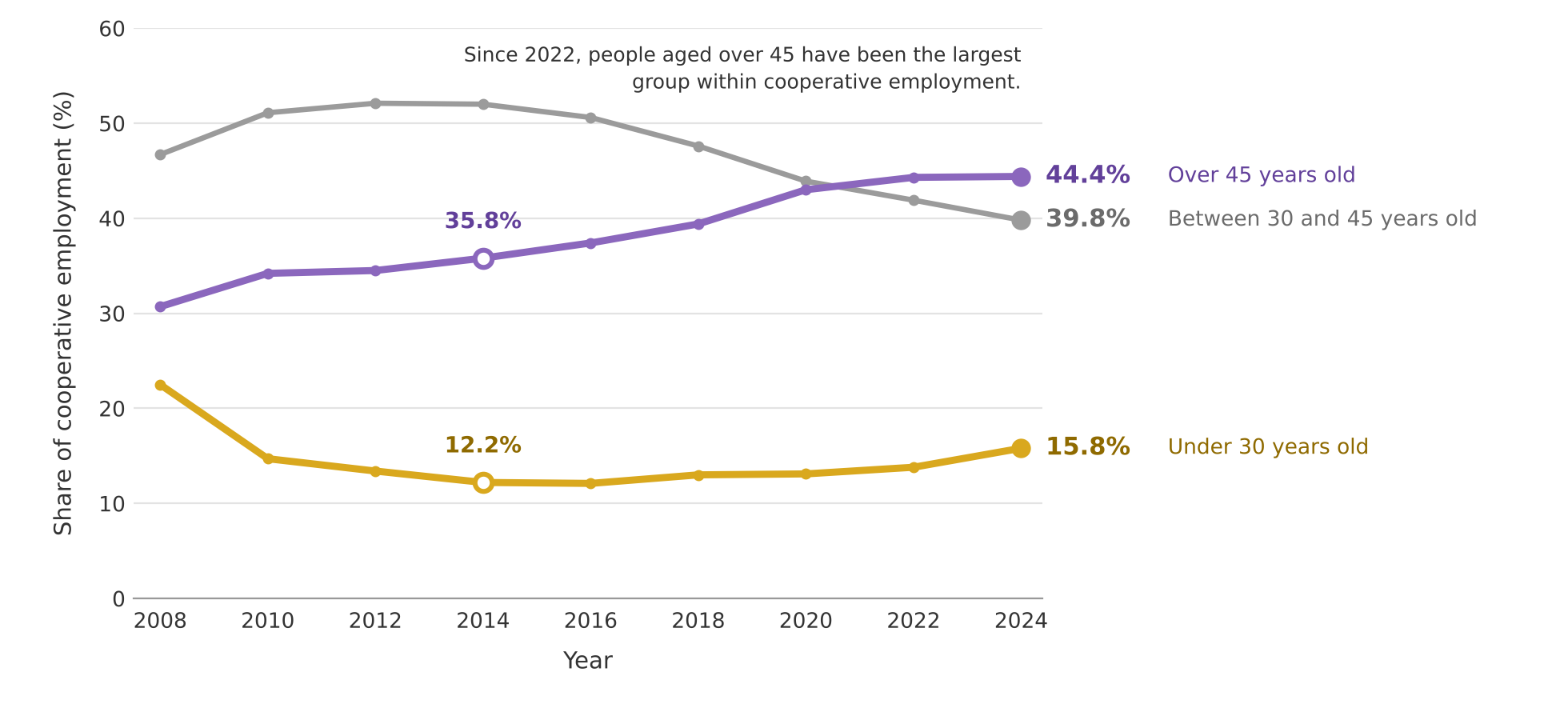
Data from the Basque Social Economy Statistics 2024 show this clearly. Over the last 15 years, the share of older workers in cooperative employment has increased, representing the largest age group. In 2014, people over 45 represented 35.8% of cooperative employment; today they represent 44.4%. The share of workers under 30 has risen from 12.2% to 15.8%. The percentage of young people is growing, but less rapidly than those approaching retirement and succession.
Chart. Distribution of Cooperative Employment by Age Group (2008–2024)
Source: Basque Social Economy Statistics. Author’s own elaboration.
Companies themselves recognize the challenge. 31.2% of Basque cooperatives and worker-owned companies identify talent attraction as a concern for their future, compared with 27% two years earlier. Around one in five is concerned about workforce ageing, yet only one in five of those has implemented measures to rejuvenate its workforce. The challenge is visible; what is missing is action.
In a context where Euskadi competes to attract and retain talent, the real challenge may not simply be attracting young people, but offering projects worth staying for.
Young people are not avoiding commitment
What do those who will take over think? Kooperatiben Kontseilua interviewed 400 people aged between 18 and 30 living in Euskadi. They gave the importance of work a score of 8.15 out of 10. What has changed is its place within their life project: almost 8 out of 10 believe that employment no longer guarantees a good life. And 94.2% respond better to discipline when treated with respect by those in leadership positions.
This does not appear to be a rejection of commitment, but rather a demand for reciprocity. Participation, collective purpose, territorial embeddedness and shared value are historic features of cooperatives, but none of them are passed automatically from one generation to the next. All of them need to be reinterpreted.
Renewing the bonds
There is a great deal of discussion about business rootedness, perhaps because we have come to understand that competitiveness depends on more than investments, infrastructure or technology. It also depends on relationships: between people and organizations, between companies and territories, and between generations.
The main lesson I draw from cooperative demography is that continuity is not guaranteed by preserving everything exactly as it is, but by renewing the bonds that encourage new generations to join the project. The true test of a living economic system isn’t whether it remains unchanged, but whether the next generation still chooses to be part of it.
And what do you think? What would inspire a young person in your environment choose a cooperative?
More from Orkestra: KoopBehatokia, the Observatory of Cooperatives in Euskadi

Rakel Vázquez
Rakel, Senior IT & Big Data at Orkestra, focuses on the analysis of territorial competitiveness and supporting evidence-based decision-making through the design of indicators, the development of information systems, and the creation of territorial strategic intelligence tools