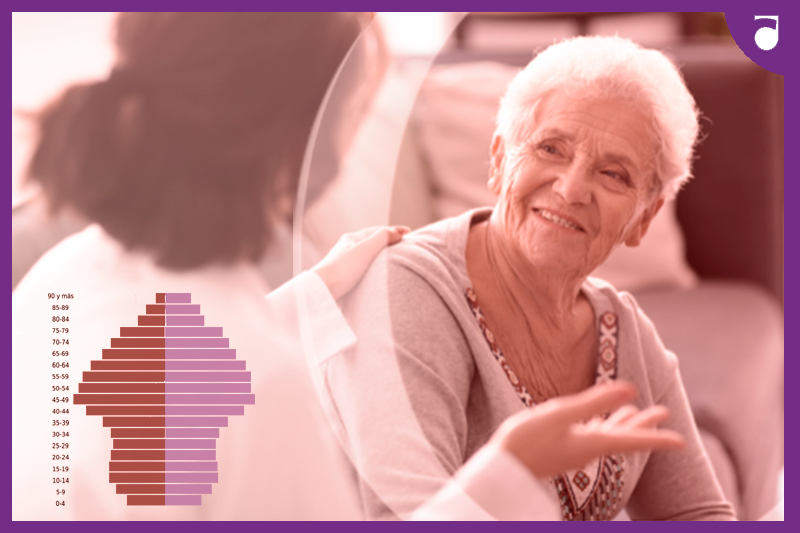
The demographic challenge is now a reality that calls into question the distribution of resources, the provision of services, and the organisation of care. Increasingly, media discourse warns of a supposed conflict between generations, highlighting the great challenge this poses to social cohesion. However, its impact on gender inequality is rarely discussed. Failing to consider the demographic challenge from a gender perspective not only prevents us from properly understanding the phenomenon, but can also lead to solutions that exacerbate this inequality.
Firstly, we must fully understand the origins of this challenge. The Basque Country is experiencing a demographic transformation, which is being driven by three key trends: falling birth rates, increased life expectancy, and positive net migration. These trends are changing the proportions of different population groups. In other words, the structure of the Basque population is changing. And it is doing so in two main ways: the proportion of people of foreign origin is increasing, and the population is ageing, which increases the proportion of older people and the average age of the working population.
The literature suggests that ageing has a negative impact on the economy by affecting business activity, human capital and innovation (Aiyar et al., 2016; Anghel et al., 2023; Liang et al., 2018), while also increasing the need for care and welfare policies (Conde-Ruiz & Galasso, 2023). The challenge is therefore enormous: ensuring inclusive wellbeing in a more fragile society with a less dynamic economy.
In this context, the issue of intergenerational relations is of great importance. In the literature, this issue is studied under the label of 'intergenerational solidarity', which is understood as 'social cohesion between generations' (Bengtson & Oyama, 2010; Bengtson & Roberts, 1991). In reality, every society must address the fact that, for physiological reasons, some generations are more dependent than others, although how this is achieved may vary depending on cultural and institutional factors. In our case, this solidarity has both a public and a private dimension: the former involves institutions that guarantee resources and services to the 'dependent' generations, while the latter involves the family as the fundamental unit. It is important to note that this model is specific to societies with structural differences between men and women, which are also evident at these two levels.
Within the family, the responsibility for intergenerational solidarity largely falls on women, who devote more time to caring for children and other family members. Indeed, 87% of leave taken to care for children and 72% of leave taken to care for other family members is granted to women (Emakunde, 2024). Furthermore, among the over-50 age group, women make and receive more intergenerational visits than men; however, they are also more likely to experience loneliness due to their longer life expectancy (López López et al., 2015). This greater longevity, together with differences in working life, helps to explain the gender gap in pensions (Emakunde, 2020).
Outside the family, women demonstrate greater intergenerational solidarity than men within the community. For instance, they offer more support to non-relatives (Jiménez-Roger & Sánchez, 2023) and are overrepresented in the third sector, with three out of four workers in the Basque Country being women (Basque Observatory of the Third Social Sector, 2025).
At an even more aggregate level, we can observe how these gendered patterns of intergenerational solidarity persist. Firstly, the care resources and services provided by the public sector are feminised, with women being overrepresented in public administration, education and health (Aranguren et al., 2024). According to Eustat data, 69% of people employed in social services in the Basque Autonomous Community are women. This percentage increases considerably among service personnel (80%), cleaning staff (90%), and healthcare and technical personnel (88%). This has an impact on the workplace: 75% of workers whose conditions are not regulated by a collective agreement are women (LAB, 2021).
These trends are also reflected in values and opinions regarding intergenerational solidarity and the role of the state. There is a gender difference in preferences for higher public spending, which is greater among women (Kohli, 2006). This greater support also applies to welfare policies for the elderly and public pensions (Riekhoff, 2021).
In short, there is a growing demand for care, and intergenerational solidarity is proving to be a central pillar in addressing this demand. However, this solidarity is not neutral, as it is based on gender inequalities that cut across both the family and institutional spheres. Addressing the demographic challenge from an inclusive wellbeing perspective requires acknowledging these asymmetries and rethinking the distribution of responsibilities, resources and care between men and women, but also across other dimensions such as origin or social class. For the demographic challenge is not only about readjusting to a new population structure, but also about completely rethinking the model of wellbeing we seek to build in the coming decades.

Josep Soler
Josep is a predoctoral researcher at Orkestra. He holds a Bachelor's degree in Economics from the University of the Balearic Islands and a Master's degree in International Economics and Development from Complutense University, Madrid.