In the September 2025 issue of National Geographic magazine, an article reflected on the possibility of living on the Moon and, as they know so well how to do, the authors presented scenarios, data, research, and interviews in a very educational and engaging way. At one point, they raised the possibility that there could be water ice of cometary origin at the bottom of a crater. This option opened up the possibility of using electrolysis to obtain hydrogen to produce fuel and oxygen. No big deal! It is true that they later explained that this was not as simple as it seemed.
Related to this topic, but in the terrestrial context, we recently published two reports on hydrogen: Prospects for the development of international trade in hydrogen and related products. Potential implications for ports and Potential of the port of Bilbao in hydrogen transport.
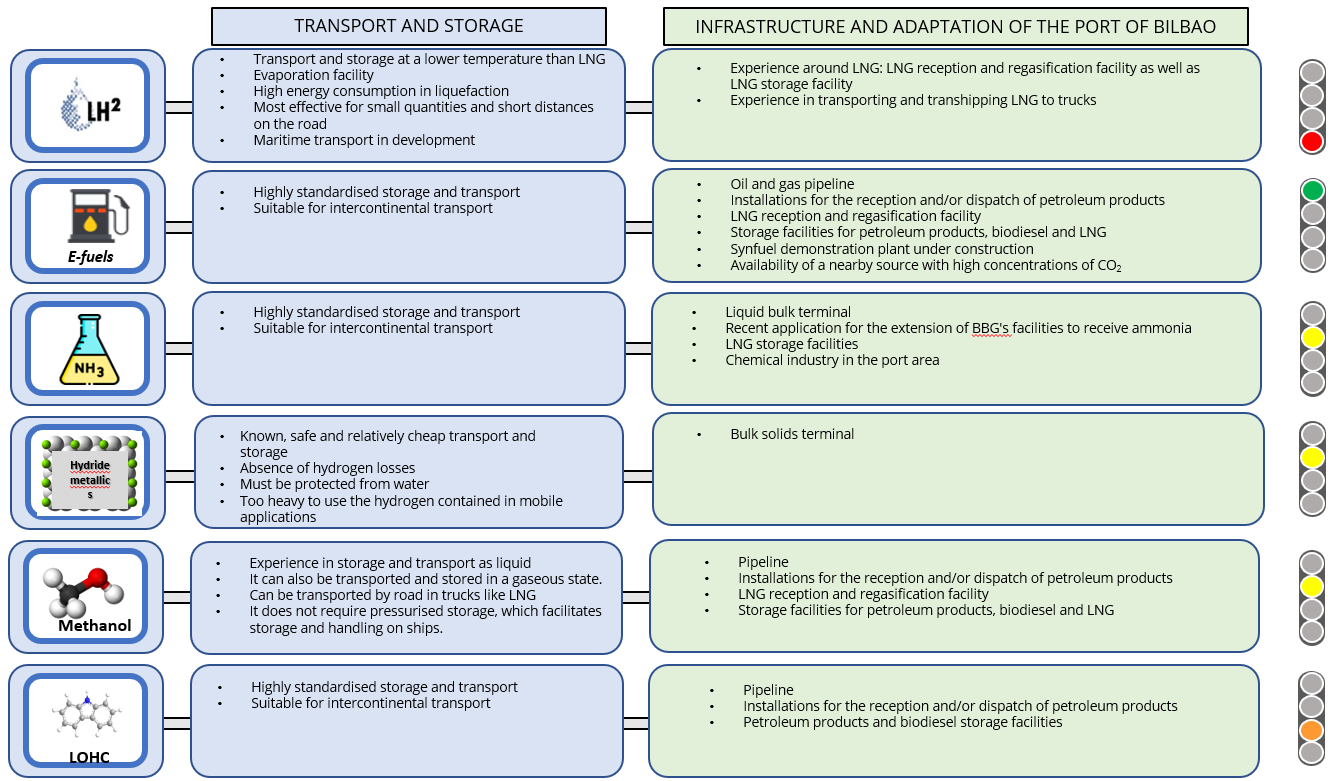
In the second report, the aim was to provide an overview of the potential of the port of Bilbao as a port logistics hub for the (renewable) hydrogen value chain and to compare the most viable options or carriers for doing so.
To understand the potential role of the port of Bilbao as an operations center or logistics hub for renewable hydrogen, a series of questions must be answered, including: what is the demand and supply of hydrogen, what transport and storage infrastructure is available, and whether any regulations are driving or, on the contrary, paralysing demand and supply or infrastructure. Other questions include how hydrogen can be transported, what market these alternatives have, and their economic, technological, and regulatory viability, among others.
Below are some of the main conclusions of the study. Firstly, there is a low volume of new demand for hydrogen in the Bilbao port area beyond the current demand, which comes from the Petronor refinery and, to a lesser extent, from the chemical sector, for the manufacture of fertilizers, plastics, synthetic rubber, and basic chemicals. The existence of potential demand for renewable H2 and/or carriers in the area would be key for the port of Bilbao to position itself as a logistics center in the hydrogen value chains. Likewise the port of Bilbao is sufficiently connected or is expected to be connected by land or pipeline (with gas or hydro pipelines) to potential points of supply and demand for hydrogen.
On the supply side, it would be key to unlock the port's renewable potential. This could be a way to create a living lab for green hydrogen demonstration projects or carriers such as synthetic fuels, for which a pilot plant is being built. Given both the lack of renewable production in the Basque Autonomous Community and the lack of connection capacity to the electricity grids, a port producing renewable energies, among others, could contribute to reducing external dependence on renewable electricity and on the electricity grid itself for hydrogen or carrier projects. To this end, it would be key to join forces within the port community.
The future connection by hydro-duct with the rest of Europe is seen as an opportunity for the strategic positioning of the port since, on its way to Northern Europe, Bilbao is the last Atlantic port with a direct connection to the H2med project. In this way, a more distant and higher volume demand could be met, although other closer and potentially feasible options could appear. The port of Bilbao could also become a stopover for refuelling ships with ammonia, and its production could be of interest to meet the demand for fertilisers, especially in northern countries, where they are much needed and their green production is more expensive.
Based on the analysis carried out in this study, it can be said that despite the uncertainty surrounding hydrogen, there are factors that suggest it should not be ruled out, for the time being, as an energy vector; however, we must remain alert to possible changes. In the first phase, the deployment of hydrogen should be considered in terms of proximity between supply and demand points. The decreasing price evolution of green hydrogen will be key to achieving the penetration of this energy carrier, together with a stable ad-hoc regulatory development.
The strategy for deploying infrastructure in ports must take into account their potential strengths in relation to green hydrogen value chains and carriers. In this regard, one element to consider is the potential uses of green hydrogen in targeting the most suitable carriers in each case. In this regard, and returning once again to the Moon, I have discovered that one of the potential uses of hydrogen is as a propellant for spacecraft.
Although, once again, there are drawbacks (it seems that nothing is perfect), such as the need for large tanks, the need for production to be adjusted to the launch schedule, and the preference for liquid hydrogen, its application for propulsion is based on the efficiency derived from combustion heat, which is three times greater than that of kerosene (the other fuel used in space launchers). In any case, the volume required for a mission will be very high and will face new challenges in terms of cost and technology. But what if one day we return to the moon with green hydrogen sent from Bilbao?

Macarena Larrea
Macarena Larrea, Researcher at Orkestra, holds a Ph.D. in Business Fostering and Development from the University of the Basque Country, she wrote her thesis on the “Internalization of the External Costs of Electricity Production”.