30 September 2026
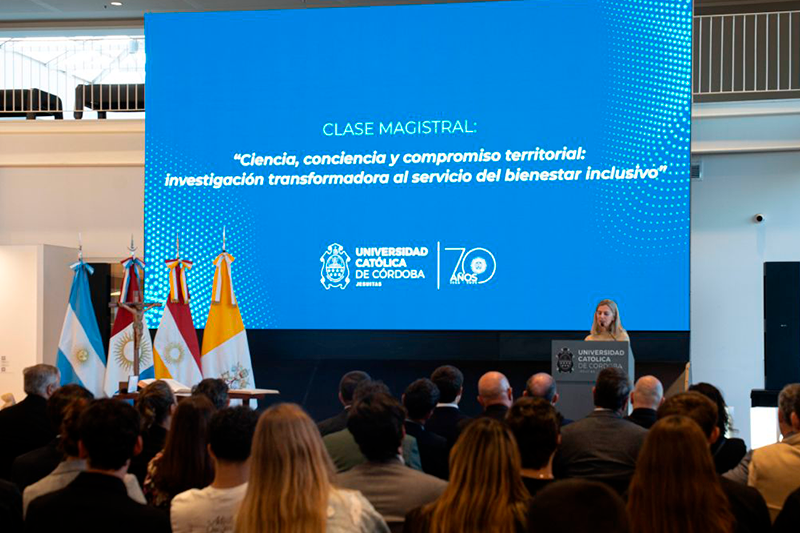
©️ Image: Catholic University of Córdoba
- Orkestra would like to extend its warmest congratulations to its former General Director on this appointment
- Following the investiture ceremony, Aranguren delivered a keynote lecture in which she shared the key features of the Basque competitiveness model and the transformative research approach developed by the Institute
Mari Jose Aranguren, Orkestra’s General Director from 2013 to 2025 and currently Vice-Rector for the San Sebastián Campus and Institutional Relations at the University of Deusto, has been awarded an honorary doctorate by the Catholic University of Córdoba (UCC) in Argentina. The distinction recognises a career dedicated to understanding and contributing to the transformation of territories through collaboration, applied research and stronger links between knowledge and action.
During her twelve years leading Orkestra, Aranguren helped consolidate a research model focused on generating knowledge with and for territorial stakeholders. This approach connects research with public policy and with the business and social realities of the Basque Country.
In the keynote lecture she delivered following the investiture ceremony, Aranguren outlined the key features of the Basque competitiveness model and reflected on the role that governance, collaboration among stakeholders and transformative research can play in territorial development processes.
She highlighted the need to overcome the difficulties created by fragmented governance, in which public administrations and organisations often work in isolation. In contrast to this silo-based approach, the Basque model seeks to strengthen governance through alliances between public administrations, businesses, development agencies, and education and technology centres.
In this context, transformative research plays a key role. Rather than relying on a linear transfer of academic knowledge, this approach seeks to co-create knowledge and solutions with territorial stakeholders. It does so by creating spaces for dialogue where different actors can work together on shared challenges.
A tool for understanding the factors that shape competitiveness and wellbeing
One of the central themes of Aranguren’s lecture was the evolution of the Competitiveness for Wellbeing Framework developed by Orkestra. The framework broadens the traditional understanding of competitiveness by also taking into account dimensions related to people’s wellbeing. “Territorial competitiveness and people’s wellbeing are not opposing poles or independent goals. They are two sides of the same coin and need to be connected in a virtuous circle,” she stressed.
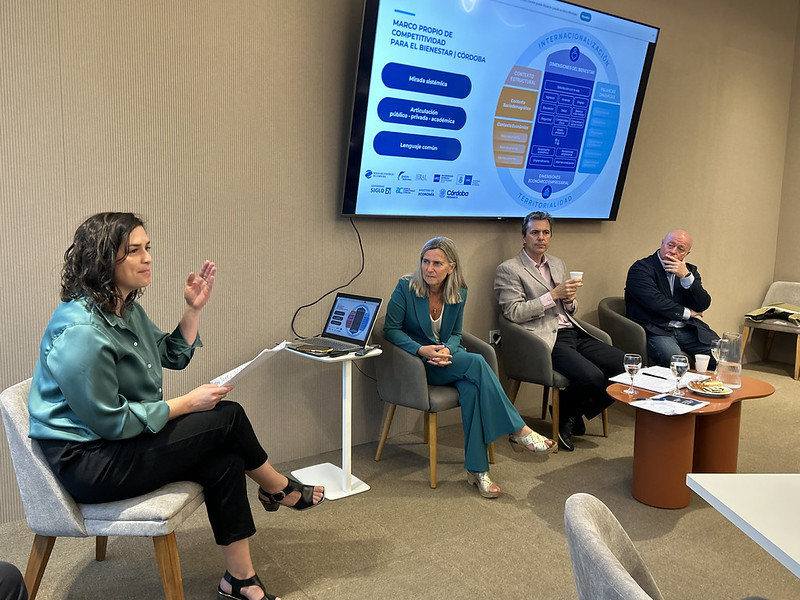 This perspective was also at the heart of a conference organised on 28 September by the Ministry of Production, Science and Technological Innovation of the Province of Córdoba. The event explored in greater depth the collaboration between Orkestra and the Córdoba Competitiveness Agency.
Aranguren was involved in this project during her time as Director General of Orkestra. Its aim was to support the province in developing its own Competitiveness for Wellbeing Framework, adapted to its specific characteristics and needs. The framework was designed as a tool to understand the factors shaping the province’s development and to support decision-making.
This experience is an example of how Orkestra shares and adapts its knowledge in other territories. Rather than directly transferring the Basque model, these collaborations seek to put the knowledge generated in the Basque Country at the service of reflection and learning processes in other contexts, adapting it to their specific characteristics, capabilities and challenges. In this way, international collaboration not only provides an opportunity to share the experience accumulated in the Basque Country, but also helps Orkestra test and enrich its own knowledge by learning from the realities of other territories.