21 November 2016
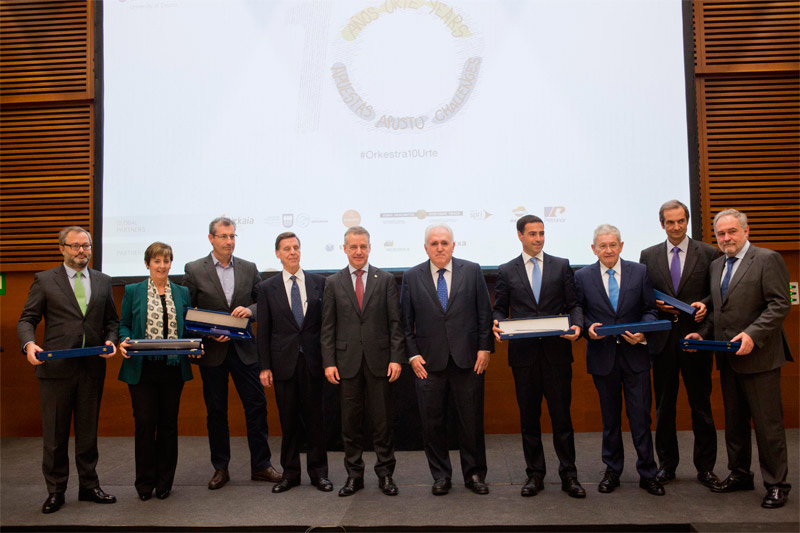
The Basque Institute of Competitiveness-Orkestra, sponsored by Deusto University, hosted an event in Donostia today to commemorate its 10th anniversary. The event, presided over by the Ignacio Echeberria, provided an opportunity to offer a preview of the Orkestra Case, elaborated by the Harvard Business School, which will be presented in Boston in a few days’ time. Furthermore, via this event, Orkestra seeks to initiate an extensive process of social reflection with regard to the ten main challenges facing the Basque Country in the years to come. All from a vision contemplating an improvement in competitiveness as an essential factor in order to continue making progress in the social welfare of the territory.
The Lehendakari Iñigo Urkullu joined in “the recognition of Orkestra, Deusto University and all the people who set up and have supported this project during these first ten years”. This is, added the Lehendakari, an exemplary initiative from the point of view of shared diagnosis, country strategy and public-private collaboration.
Also participating in the inauguration of the event were the president of Orkestra, Ignacio Echeberria, who highlighted the role played by Orkestra in the transformation of the Basque Country, and the rector of Deusto University, José María Guibert, for whom the principal merit of the University, in sponsoring the Institute, was to ensure that it benefitted the whole of society. Both also emphasised the period of consolidation and management of the project, which involved over two years of conversations between different public and private organisations, and which is one of the keys that explains Orkestra’s evolution.
Harvard studies the Orkestra Case
It is the configuration of Orkestra as a space for public-private collaboration committed to the territory that has been one of the most significant aspects in the elaboration of the Orkestra Case by Harvard University. Harvard cases are a reference worldwide, and the fact that there has been a case study on Orkestra confers considerable prestige upon the Institute and greatly strengthens its international position.
Another of the elements highlighted by Harvard in the Orkestra Case is the research model developed, given that there exist no other international references when it comes to merging academic research, teaching and interaction with the territory’s agents. This was explained in their speeches by the authors of the Orkestra Case: Christian Ketels, doctor at the Harvard Business School, Jesús María Valdaliso, professor at the University of the Basque Country, and professor Michael Porter, professor at Harvard University and world expert in strategy and competitiveness.
In his speech, Porter linked Orkestra’s 10th anniversary with the 25th anniversary of the application of development strategies and competitiveness policies in the Basque Country. “The Basque Country,” he said, “is an international model in the development of cluster policy. And to lend further momentum to this process, the creation of Orkestra has meant the development of one of the main world think tanks in the promotion of clusters and competitiveness. You do not know how much influence you have in this relatively small region where you live. Orkestra has been fundamental in this process. Today, the influence of Orkestra and its research transcend the borders of the Basque Country. It has become a leader in Europe and is very influential in the design of policy at a European and global level. We cherish our association with Orkestra and its participation in the global effort to study and drive improvements in competitiveness. I think that all of you here this afternoon can be extremely proud of what you have done”.
10 challenges for the future
Orkestra has prepared, on the occasion of its 10th anniversary, a Manifesto entitled “Towards a New Normality” in which it identifies ten major future challenges that must be addressed by the Basque Country from the perspective of continuing to strengthen competitiveness in order to consolidate a space of progress, welfare and social cohesion. The main challenge for the future identified by Orkestra is to advance in a coordinated manner between all the agents in the territory to design a unique and integrated response to the challenges to come. With the shared goal of reinforcing the Basque Country’s competitiveness in order to consolidate a social space of progress and coexistence, understanding competitiveness via an integrated vision that seeks wellbeing for the greatest possible number of people.
The Regional Innovation Director of the OECD, Karen Maguire, provided a global perspective of the likely scenario during the years to come.
In the case of the Basque Country, the Director General of Orkestra, Mari Jose Aranguren and the sociologist from Deusto University, Felix Arrieta, discussed some of these challenges, especially those related to training, new models of business organisation or labour relations. In any case, said Maria Jose Aranguren, “it is time to take action; we have been talking about several of these challenges for a long time, in some cases with timid initiatives, but we need to address them with a proactive attitude”.
A process of reflection and debate
Orkestra seeks to open a process of reflection with regard to these ten major challenges with the participation of other social agents. To this end, in collaboration with Forum Deusto, different cycles and meetings will be organised so as to allow deeper analysis of each challenge.
The first cycle is devoted to addressing competitiveness in the service of social welfare, over four sessions. The first will take place in February, with the participation of Mathias Firgo, member of the Austrian Institute of Economic Research, an expert in reconciling the duality of welfare and competitiveness. The second conference will take place on March 30 with a round table involving the third sector, the institutional sphere and world experts in knowledge of this field. The third conference, in April, will consist in the analysis of the experience of a region that is advanced in the application of this model, with the participation of a high-level institutional representative who will explain this experience. Finally, in May, this challenge will be addressed from the Basque Country’s perspective with the participation of representatives of the political parties in the Basque Parliament.