22 April 2026
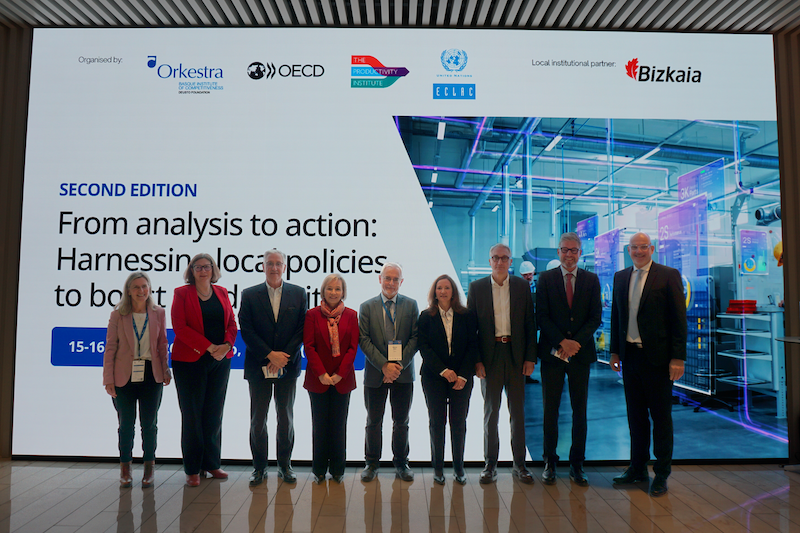
Organisers of the conference together with members of the policy panel during the event.
- On the 15th and 16th of April, Bizkaia hosted the second edition of the international conference “From Analysis to Action: Harnessing Local Policies to Boost Productivity”
- More than 25 speakers explored some of the key challenges facing regions in a context shaped by technological, energy and demographic transitions
- The conference highlighted the need to advance towards more coherent, evidence-based policies tailored to the specific characteristics of each place, strengthening the link between analysis and action
Bizkaia hosted the second edition of the international conference From Analysis to Action: Harnessing Local Policies to Boost Productivity, organised by Orkestra, in collaboration with the OECD Trento Centre for Local Development, The Productivity Institute and the Economic Commission for Latin America and the Caribbean (ECLAC), with the support of the Government of Bizkaia. Over two days, experts from around the world discussed how local public policies can drive productivity, competitiveness and wellbeing.
Across five thematic sessions, more than 25 speakers addressed some of the key challenges facing regions in a context of technological, energy and demographic transitions. Discussions reinforced the importance of adopting a place-based approach to better understand and act upon the drivers of productivity, integrating dimensions such as knowledge, skills, sustainability and inclusion.
The chairs of the five sessions synthesised the main insights from the conference in the closing summary, moderated by our General Director, James Wilson. Several key messages emerged that point to the future direction of public policy in this field:
- The importance of thinking systemically about place-based knowledge flows, gaining a deeper understanding of how knowledge is generated, circulated and applied within territories to support productive transformation.
- The need to continuously assess and challenge the impact of artificial intelligence on regional skills ecosystems was highlighted, recognising the speed and scale of ongoing changes.
- The potential of the green transition as a lever to enhance local productivity, provided it is accompanied by policies that support skills development and adaptation.
- The importance of ensuring inclusion, both within and between places, placing equity at the centre of productivity-oriented policy design.
- The need to address short-term challenges arising from today’s volatile context within a clear long-term strategic framework for territorial competitiveness.
Overall, the conference reinforced the importance of advancing towards more coherent, evidence-based policies that are tailored to the specific characteristics of each place, strengthening the link between analysis and action. A synthesis document summarising the key messages from the conference and compiling all presentations is now available.
Orkestra’s contribution to the event
The event started with welcome remarks from Orkestra’s president, Ivan Marten, who underlined that “events like this provide a unique opportunity to exchange experiences, learn from international perspectives, and reflect on what works across different contexts”. In this regard, he pointed to the innovative format of the conference, specifically designed to bridge academic insights with practical solutions that policymakers can apply on the ground.
Within the conference programme, Edurne Magro, Senior Researcher at Orkestra, presented insights from the Bizkaia Orekan Sakonduz project, which focuses on analysing territorial competitiveness and supporting the design of policies aimed at fostering more balanced and inclusive development in Bizkaia. Her contribution highlighted the importance of detailed, place-sensitive diagnosis to better inform public action and strengthen territorial cohesion.