26 February 2026
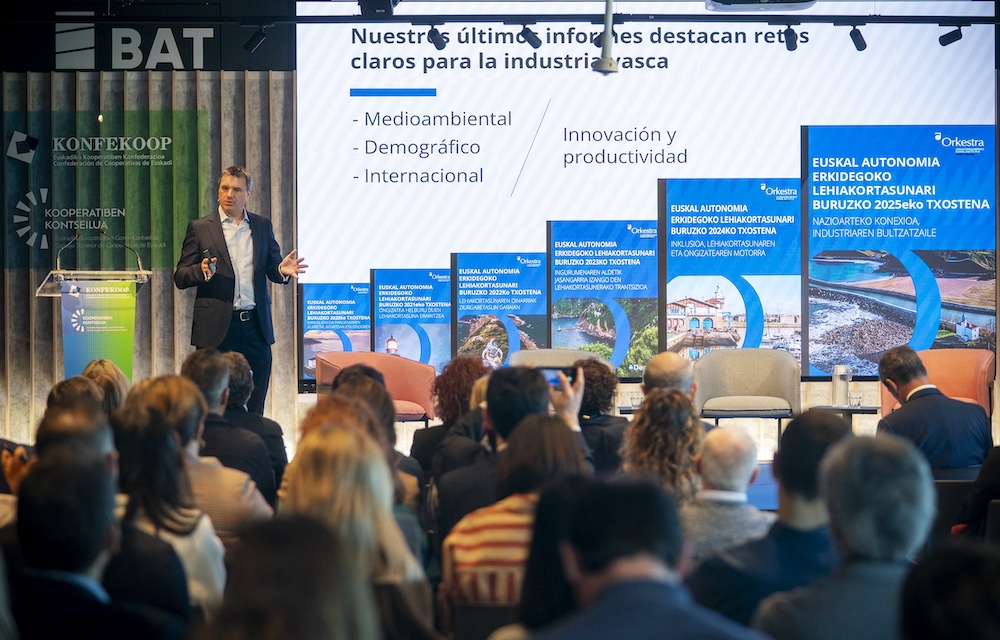
Image courtesy of the Council of Cooperatives
- Council of Cooperatives and Orkestra have presented the new Basque Country Cooperative Companies Observatory in Bilbao (https://koopbehatokia.eus/).
- This platform analyses and disseminates the contribution of Basque cooperatives to the business landscape, economy and society.
- KoopObservatory's initial analyses highlight the impact of cooperatives in five key areas: generating quality employment, internationalisation, continuous innovation, territorial balance and social cohesion.
The Basque Country now has a new tool for analysing and showcasing the distinctive contributions of cooperatives to the region's competitiveness and wellbeing. KOOPERATIBEN KONTSEILUA, the Higher Council of Cooperatives of the Basque Country, and Orkestra presented KoopObservatory, the Observatory of Cooperative Companies of the Basque Country, in Bilbao as part of the conference 'The strategic role of cooperative companies in the competitiveness and industry of the Basque Country'.
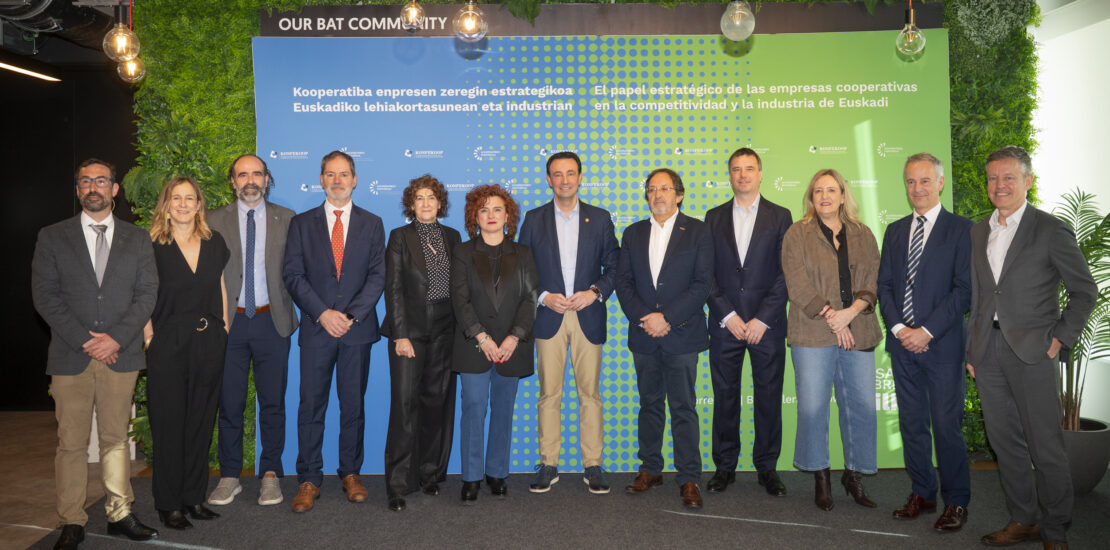
This event, held at the BAT Tower, included the participation of Patxi Olabarria (President of KOOPERATIBEN KONTSEILUA), Mikel Torres (Vice-President and Minister for Economy, Labour and Employment of the Basque Government), Rosa Lavín and Mikel Larrea (President and Director of KONFEKOOP), and Mikel Jauregi (Minister for Industry, Energy Transition and Sustainability of the Basque Government), as well as other institutional and business representatives.
James Wilson, the Managing Director of Orkestra, gave the keynote speech. He presented the new observatory and analysed the Basque Country's competitive and industrial context, its main challenges, and how cooperative enterprises can contribute to addressing these challenges. “Our most recent analyses of competitiveness and wellbeing in the Basque Country highlight the need to promote sustained innovation and productivity using an approach aligned with our socio-economic model. In this context, cooperative enterprises offer unique value in addressing these challenges thanks to their ability to balance economic, environmental and social factors,” he said.
KoopObservatory is an observatory that aims to systematise the social and territorial impacts of cooperativism
It is not simply a data repository, but rather a space for analysing, disseminating and sharing knowledge about the reality of cooperativism in the Basque Country. As both James Wilson and Patxi Olabarria explained during the event, KoopObservatory was created to highlight the added value of the cooperative model and its impact on the territory. It is also intended to strengthen the industrial competitiveness of the Basque Country.
The observatory's three main objectives are:
-To measure and highlight the contribution of cooperatives to the business landscape, the economy, society and individuals.
-Secondly, it aims to offer a reference platform that provides key data for decision-making, public policy design, and the strengthening of the Basque cooperative ecosystem.
-The third objective is to analyse the current state of cooperatives in multiple dimensions, such as demographics, employment, innovation, competitiveness, and social and territorial impact.
Additionally, KoopObservatory incorporates an interactive map displaying the territorial distribution of cooperatives, alongside a section that will periodically be updated to include publications and studies on cooperativism.
Cooperatives are much more than just a legal formula
The initial analyses conducted within the framework of the Observatory demonstrate that cooperativism encompasses far more than just a legal structure; it represents a philosophy of work, the economy, and society. Participation, equity and solidarity are the fundamental pillars of this model. In the Basque Country, this translates into thousands of collective projects, with industrial cooperatives playing a particularly important role in both traditional and emerging sectors.
KoopObservatory demonstrates that Basque cooperativism contributes significantly to the Basque Country in five key areas:
- Generation of quality employment: Regions with the highest percentage of cooperative employment in the Basque Country perform better in variables associated with equality, such as the registered unemployment rate and the weight of industrial employment.
- Internationalisation and leadership in global niches: 23.7% of leading international companies in niche markets, also known as Hidden Champions, are cooperatives.
- Constant innovation: 6.2% of cooperatives carry out R&D activities, compared to 0.9% of businesses of a similar size and in a similar sector.
- Territorial balance: Cooperatives are distributed throughout the territory, generating employment, innovation, and social cohesion at a local level.
- Social cohesion and wellbeing: Regions in the Basque Country with a higher level of cooperative employment demonstrate a more balanced situation in terms of equality indicators. This is particularly evident in the S80/S20 ratio, which illustrates the disparity between the per capita income of the top 20% and the bottom 20% of the population.
Through the launch of KoopObservatory, Orkestra is strengthening its commitment to connecting academic research with the challenges faced by the Basque Country, providing a valuable resource for the cooperative ecosystem and wider society.