09 October 2018
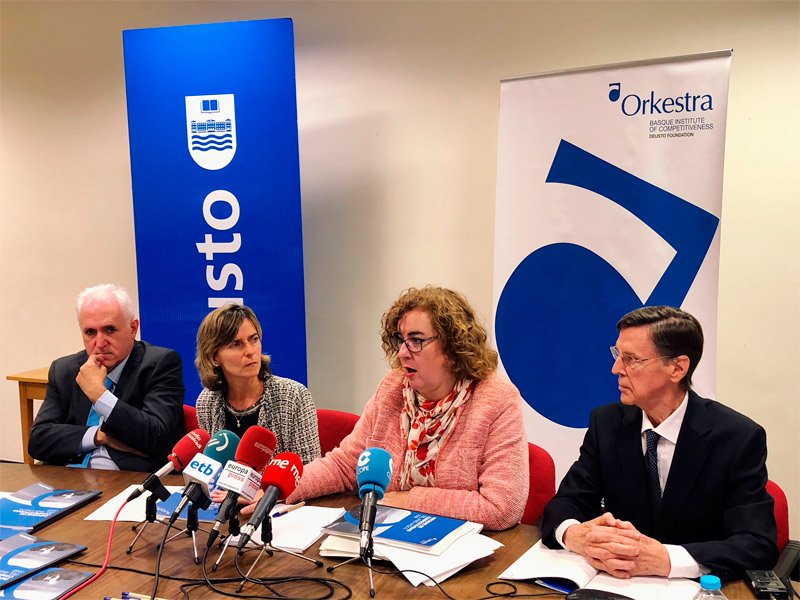
- It recommends facing up to existing challenges in order to anticipate future signs of economic downturn.
- El The report draws attention to the inclusive recovery of the Basque economy and the improvement in its economic and social results.
- Orkestra has also presented the Competitiveness Observatory, which measures the main socio-economic indicators in real time
The 2018 report on Competitiveness in the Basque Country points to the fact that the recovery is managing to avoid possible economic dualities, in which a part of the population or companies continue making advances while others remain excluded from such development. Per capita GDP has increased, as has the satisfaction with life index, and poverty levels have improved to a larger extent than in other regions. In terms of business performance, productivity levels have increased, and companies are finding themselves to be in a solid financial position. Having said this, the work carried out by Orkestra-Basque Institute of Competitiveness is calling for advantage to be taken of existing conditions so as to be prepared for any signs of economic downturn which, to a major extent, are determined by the world economic situation.
Specifically, the report points out that the change in context – driven by the rise in interest rates and a spike in the price of energy and appreciation of the Euro - in addition to geopolitical changes in the form of Brexit and Trumponomics - mean that the socio-economic future of the Basque Country remains uncertain. This is in part due to the features of specialisation prevalent in our economic and high opening-up rates, and to this must also be added the challenges being faced in the medium term with regard to demographics and climate change.
Orkestra’s diagnosis, which measures over 50 socio-economic indicators, focuses on the need to improve and address aspects such as unemployment- especially long-term unemployment, female and youth unemployment. Despite the fact that these levels have improved in recent years, they have not experienced such positive evolution in comparison to European regions with similar features which the report compares to the Basque Country. To the challenges facing employment should be added the automation of work, for which purpose the Orkestra report calls for closer strategic collaboration between educational establishments, business, government and society in order to ensure a quality job future. In this respect, it adds that the social challenges can be viewed as an opportunity to create jobs over the coming years.
Likewise, the report urges the fact that, to make economic growth and employment possible, our international market share should be increased. Along these lines, although the data gathered points out that our basic regular exports have risen, these continue to operate in small volumes. Orkestra therefore maintains that internationalisation policies should take advantage of regular exporters and foster their exporting intensity.
To this end, it also stresses the need to innovate, as a fall in expenditure on R&D has been noted in recent years despite high levels of business innovation being enjoyed. The innovation in question is more efficient, but levels of patents and community designs are not in line with the expenditure made. SMEs continue falling behind in this area, and they need to be involved in innovation, especially in that of an organisational and commercial nature.
The work also refers to unit labour costs, which have continued to evolve positively thanks to the increase in productivity and wage moderation, even though they remain high. To avoid this type of competition, the report calls for investment in innovation and for advantage to be taken of companies’ solid financial position so as to increase this type of investment.
Some aspects of education and adaptation of the educational system to future job requirements remains a matter pending in the Basque Country. Student levels in tertiary education are high in comparison to the other regions and countries on which the report bases its comparison. However, the data analysed in the report detects a gap with regard to the percentage number of individuals with intermediate qualifications.
In terms of specialisation in the Basque economy, the report stresses the need to prioritise sectors and strengthen the weak links in the chain with regard to commercial, technological and scientific specialisation. Thus, the data shows that the metal-mechanic sector is noteworthy in terms of competitiveness owing to its extensive development in those three areas, although it also focuses on the need to work on areas of information and communication technologies (ICTs), which are key to the RIS3 strategy. To avoid any risks that might derive from the close link existing between our main sectors of specialisation, Orkestra recommends making advances in diversification based on related variety.