09 July 2018
Smart specialisation of territories is the strategy that the European Commission has adopted to guarantee territorial competitiveness and well being. Applying this type of strategies means working with other territorial agents and, by sharing common ideas, advancing together in an efficient orderly manner.
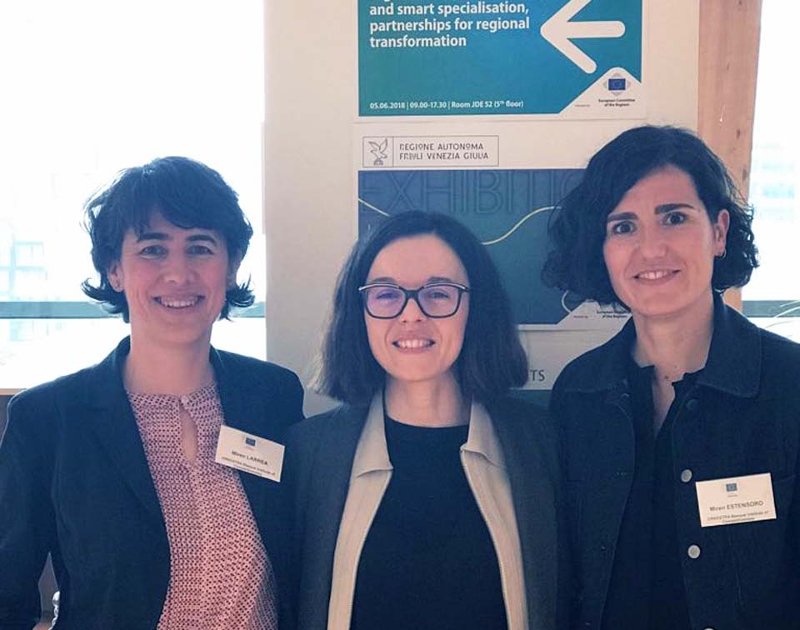
Nevertheless, as researchers Miren Larrea and Miren Estensoro of Orkestra and Eskarne Arregui-Pabollet, Scientific Officer of the Joint Research Centre (European Commission) have pointed out–in the chapter on the role of universities in governance of RIS3 strategies in the ‘Handbook on Higher Education and Smart Specialisation’–, “governance of smart specialisation raises several challenges: ranging from the horizontal coordination between ministries or government sectors to including civil society in its construction, with a key step being the need to build a vision shared by actors in the territory".
As part of the territory and a knowledge agent, universities participate, or should participate, in RIS3 governance although: What role should they play? What kind of work are they doing in this field in Europe? And in the Basque Country?
We spoke to the three authors who gave us their views on universities' role in RIS3 governance.
What is, or should be, universities’ role in governance of smart specialisation?
MIREN ESTENSORO (M.E.) Universities' potential roles will be different for each of the challenges mentioned, making the possible roles undeniably diverse: from contributing with their expert knowledge to facilitating construction of the new governance models required for smart specialisation.
In your article, you highlight that not all universities consider regional matters a priority. Is that the case in our context?
MIREN LARREA (M. L.) In the spaces where we have discussed different university models, cases like Oxford were mentioned, where 45% of the students are not from the United Kingdom and have their sights set on the international scene. We saw how these universities design their curriculums and orient their research with a view to that international positioning rather than such a strong focus on their region's specific needs. In this respect, we could say that universities in the Basque Country have a stronger regional slant when planning their activities although their objectives include international positioning. However, although they do have that vocation, the processes in which we have partaken lead us to think that we still have a long way to go to find methodologies and ways of working that will enable us to optimise the impact of university activity in society.
Do the necessary conditions exist for intervention in development of smart specialisation from universities?
ESKARNE ARREGUI (E. A.) Universities are one of the key drivers in any region's research and innovation system and even more so in a society that wants knowledge-based development. However, the evidence collected in the case studies we carried out in the HESS Project -Higher Education in Smart Specialisation- showed that universities had not been sufficiently integrated in the S3 definition and implementation and that there is still a great deal to be done. Universities also face difficulties to take part in this key governance change in R&D policies that S3 requires. Although they are already established in a territory and can make a decisive contribution through their three missions to the region’s social and economic development, they can also compete on the international scene to attract talent, occupy some of the top positions in international rankings or position their research on the world scene.
It is important that the public administrations driving this process be aware that not all universities are the same and can contribute to territorial development in the same way. Some aim to internationalise and attract top researchers while others have stronger links with Spanish and local business and others may have close connections to agents from their territory while seeking international positioning. Therefore, the universities’ interests and ways in which they can contribute to development of S3 and their governance are very broad. On the other hand, in most cases, university participation has focused on identifying their research capacities. However, the universities’ educational mission is key to ensuring the region's current and future economic development. And this takes on even greater importance when the studies they offer address the region's current and future challenges and the type of professional profiles and competences that firms need.
Are our universities prepared to contribute to joint design and development of these strategies through dialogue with agents from the territory?
M. E. The first condition is obviously sharing the challenge of wanting to work for smart specialisation and the desire to achieve it. In any case, even when researchers want to contribute to these strategies, it is often necessary to develop the capacities that this requires. We believe that researchers also need training to materialise their contribution.
Where do you think we need to concentrate at the present time so that the university will engage or work on ris3 development? In other words, where do we need to improver?
M.L. One of the subjects that is highlighted in the book is incentive systems in university research. Although the discourse is now favourable for research that engages with the territory, the reality of the situation is that promotion in academic careers is linked, above all, to a specific type of publications. This means that young researchers particularly encounter difficulties to access types of research that involve knowledge co creation with agents from the territory, which is where RIS3 seems to be evolving.
E.A. When universities include other research and management profiles that have worked on co creation, generation of knowledge, elaboration of reports and analysis, as well as public policy analysis, this may help promote the role of universities in S3. The involvement of rector’s teams in the S3 governance system is also important as the co creation process between agents means searching for each actor's role and expectations in the future development of the region, and requires deep involvement and joint reflection. Reflection in universities on their participation in S3 and their contribution to implementing them is essential.
What are the key learning areas of the projects that Orkestra is working on with different governments to develop their RIS3?
M. L. The changes that RIS3 cause in the working method is long-term, requiring changes in policy-makers and universities. Said changes do not occur spontaneously. There are normally facilitators that create the conditions for them to take place. An explicit strategy to ensure that these facilitators exist, that their role is recognised, that they have the resources they need and can acquire the training needed would be a step forward.
M. E. One of the main learning outcomes of the research processes that we have been facilitating for S3 strategy development is that action research is a strategy for building new governance models. It is therefore a territorial development strategy. Active research is not merely a research method used by researchers but also as a territorial development strategy by the other actors that take up the process.
Are there any outstanding European examples of this?
E.A. There are interesting examples in Europe and our book includes several that can serve as inspiration and reflection for other regions. The example of the Basque Country is outstanding, where Orkestra’s social sciences researchers are playing a key role in activating action research processes in the S3 framework to develop a common vision, knowledge generation of the process and search for each agent's role. Coordination of multilevel governance with Bilbao and several municipalities is also a very interesting example of how to engage sub regional administrations in S3 and the role that researchers can play as process facilitators and activators.
On the other hand, the central Loire Valley region in France is a good example of how the region has mobilised its higher education centres to develop a regional higher education, research and innovation plan that contributes to developing the universities’ role in the territory, complementary to the State higher education framework. The Public University of Navarre has activated multidisciplinary research capacities from research institutes as a means to integrate the research community in S3.
In any case, it is important to remember that these examples have worked in territorial contexts with specific characteristics which must be kept in mind as it is not always possible to replicate them in other cases.