31 January 2018
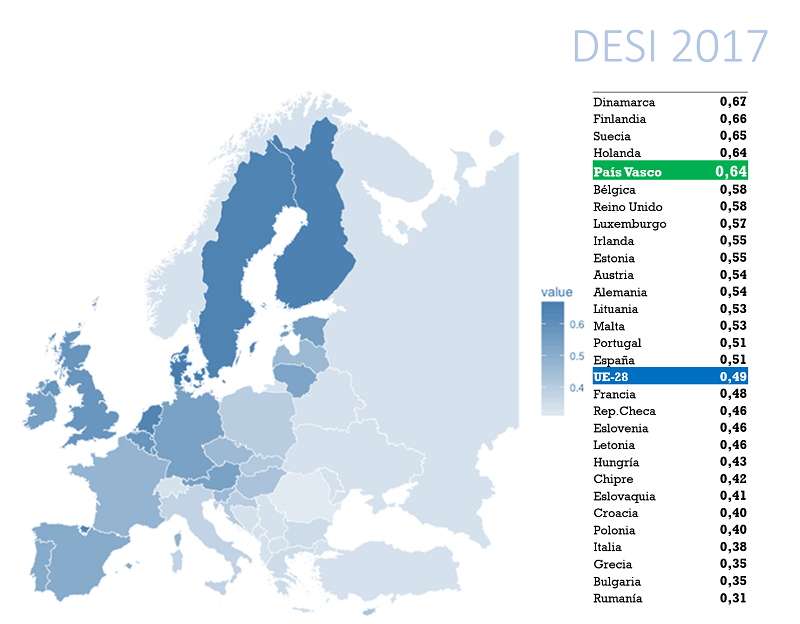
Orkestra's report on digitalisation in the Basque Country showed that the region is above the European average as per digitalisation of its economy and society. This places it in fifth position, along with the Nordic countries (Denmark, Finland, Sweden) and the Netherlands.
“Economía y sociedad digitales en el País Vasco” (digital economy and society in the Basque Country) underscores the need to intensify digital transformation in Basque firms and attract new era professionals.
The study, which forms part of the focus area on the digital economy started up by Orkestra and Euskaltel, highlights that the Basque Country has the right conditions and infrastructure to deploy the digital economy in business, public administrations and citizens' affairs.
The study measures the key indicators for the European Commission's analysis of digitalisation in the EU and compares the Basque Country with the 28 member countries.
Integration of new technologies in business and their level of sophistication place the Basque region in a leading position. Over 65% of firms have developed digitalisation processes, second only to Finland with 68%. These data are directly related with the drive to digitalise in sectors such as Industry 4.0. The report also stresses the region's high level of connectivity (80%), placing it at the top in Europe, together with the Netherlands (81%).
Among the areas for improvement, the study points out that the greatest weakness is the low rate of e-commerce transactions which barely exceed 22%, as opposed to 73% in Ireland, which heads the ranking. Online sales are far below (4%) the digital leaders which register 16%. Basque firms’ online sales is also an area that calls for improvement, with only 5% in comparison to the leaders, Ireland and the Czech Republic which register over 20%.
Basque citizens’ knowledge of digital skills is quite high, in comparison to the rest of the EU member countries. Use of new technologies is widespread in the Basque Country. In this respect, the Basque Country occupies fourth position for basic skills, i.e. habitual use and proficiency when searching for information, communicating, creating content or problem-solving.
However, the data on human capital presented in the report also highlighted the gap between graduates in the fields of science, technology, engineering and mathematics (36% in the Basque Country, well above Ireland in second place with 24%) and the percentage of employees in ICTs, which barely exceeds 2%. This latter figure on the Basque Country is among Europe’s lowest.
According to the study, in spite of a high percentage of graduates, the figure is increasingly lower for computer specialists and telecommunications graduates, which may explain this imbalance. It also states that ICTs are seen as support services and somewhat complementary to the key activities of the different sector s where they are used. The need to boost this area by bringing in specialist talent in digitalisation and this type of technologies is therefore clear. The report also suggests continuing with stimulus through public policy oriented to training and preparation of new digital era professionals in education and business.