11 May 2017
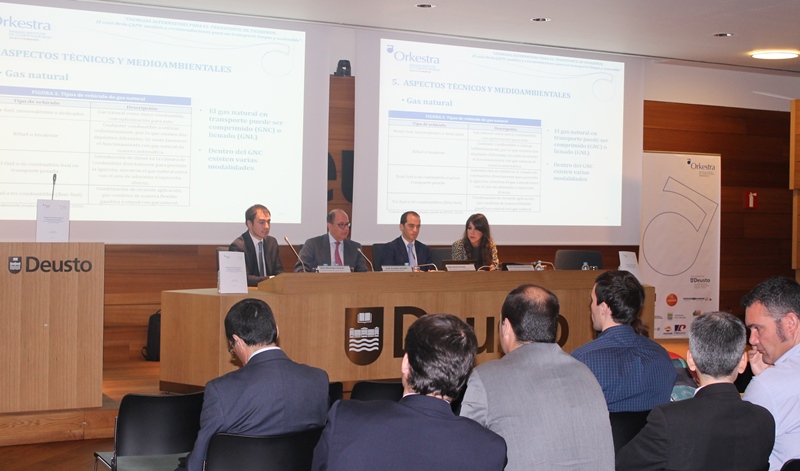
The Orkestra-Basque Institute of Competitiveness of Deusto University Energy Chair indicates 2030 as the approximate date when vehicles powered by alternative energy will outnumber conventional vehicles in the Basque Country. A report on “Alternative energies for passenger transport”, presented today, analyses the situation in the Basque Country and recommends that administrations concentrate their efforts on promoting the renewal of the car population towards the energies of the future, modifying current car population renewal policies in the conventional vehicle sector.
The report analyses energy consumption and the emissions produced by road passenger transport in the Basque Country, and indicates that “it is necessary to progress in the penetration of alternative energies or fuels in transport”. The study considers various alternative energies to conventional fuels in transport: electric vehicle –be it battery or plug-in hybrid-, compressed natural gas, liquid petroleum gas or conventional hybrid. Each of these has its own different characteristics in terms of extra costs of vehicles, investment in infrastructures, fuels or emissions.
The study was addressed via two different but complementary approaches: the total replacement of the car population and the gradual incorporation of vehicles powered by alternative energies. Thus, the former involves a vision that seeks to achieve profound and long-term structural changes. The latter is directed towards the introduction of more gradual improvements. In both cases, the evolution of future prices of electric vehicles is a key factor.
The analysis compares the different alternatives according to four criteria: fuel saving, economic-environmental efficiency for the reduction of greenhouse gases, reduced costs for overall emissions (CO2, NOx and particles) and contribution to the objectives of reducing CO2 emissions. The characteristics of each type of vehicle produce different results upon measurement of their impact upon these criteria.
Total replacement of the car population
In this case, in terms of economic-environmental efficiency, the LPG and conventional hybrid vehicles are the most efficient; in fuel savings, and indirectly in the reduction of oil imports, electric battery and natural gas vehicles achieve the best results; with regard to the reduction of greenhouse gases, electric vehicles stand out; and in relation to reduced environmental costs, plug-in and conventional hybrids lead the way.
If all the criteria are considered together and assigned different weightings, the general picture is preference for electric and hybrid vehicles, with natural gas and LPG vehicles in middle or final positions.
In overall terms, replacing all conventional cars (diesel and petrol) in the Basque Country with electric vehicles would cost 4,800 million Euros and require a 570 million Euro investment in recharging infrastructure. However, with the price assumptions included in the study, there would be an annual fuel saving of 600 million Euros, which means the recovery of the extra cost of the vehicles would occur over eight years via fuel savings. To this should be added the positive impact of the reduction of polluting emissions.
The study prepared by the Orkestra Energy Chair recommends that administrations concentrate their efforts on promoting the renewal of the car population towards the energies of the future, modifying current car population renewal policies in the conventional vehicle sector.
In this respect, the report indicates that administrations have a clear role to play via the development of incentives for the purchase of alternative vehicles, and in the promotion of supply and recharging infrastructures.