24 November 2025
- According to Orkestra, the Basque Country must diversify its risks through international connections, attract foreign investment and encourage it to take root, and promote talent and knowledge flows that are aligned with the needs of industry.
- The EU-27 remains the main trading partner for Basque companies, many of which have a significant export presence in key sectors such as automotive and metallurgy. Orkestra highlights the need to diversify markets and suppliers, manage critical value chains, and strengthen synergies between industry and advanced services.
- Foreign investments by Basque companies continue to exceed the amount of foreign capital present in the territory. Between 2019 and 2023, the stock of inward foreign direct investment (FDI) grew by an annual rate of 12.6%, with the majority concentrated in manufacturing and energy.
- Improving the attraction and integration of international talent, as well as strengthening European cooperation, will be key to adapting to the new geopolitical context.
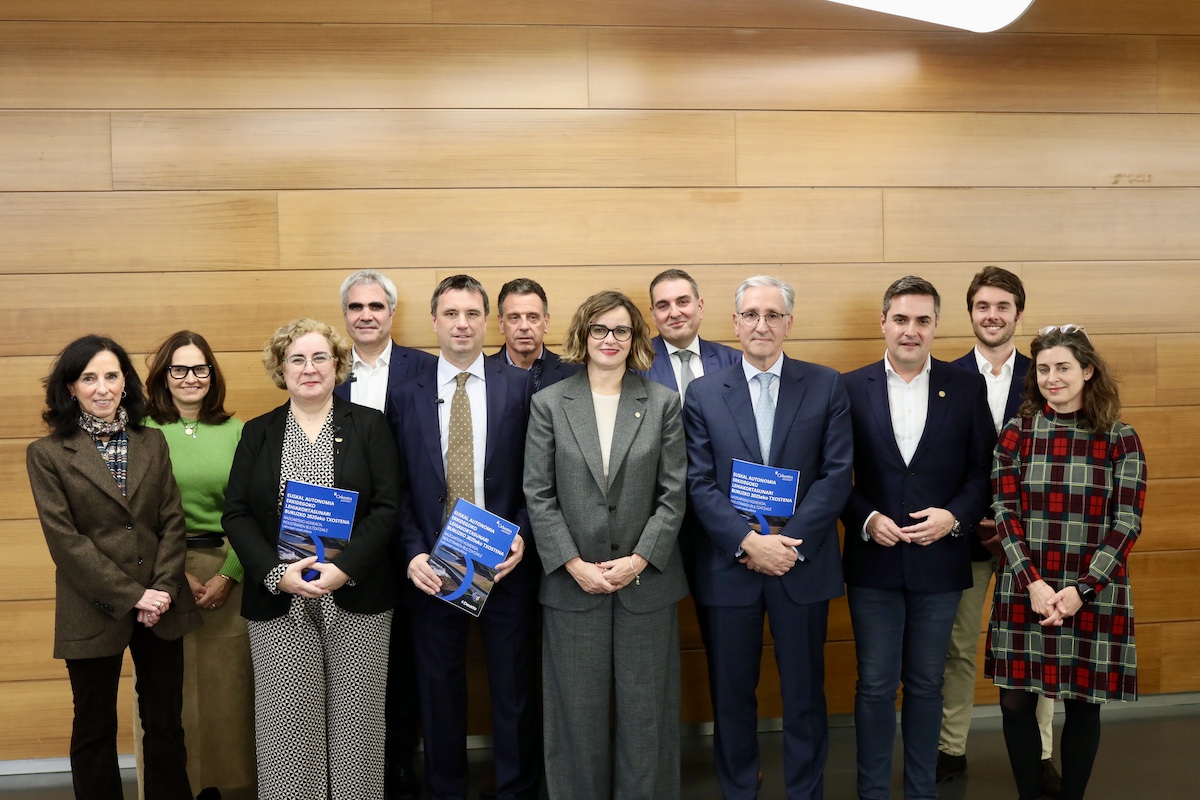
Orkestra presented the Basque Country Competitiveness Report 2025 at an event held at the University of Deusto and attended by the Deputy General of Bizkaia, Elixabete Etxanobe, and the Minister for Industry, Energy Transition and Sustainability of the Basque Government, Mikel Jauregi.
The report, entitled 'International connectivity, a driver for industry' and produced in collaboration with the SPRI Group, highlights the strong position of the Basque Country in terms of competitiveness and wellbeing in the face of the new geopolitical context. During the opening of the event, the president of Orkestra, Iván Martén, stated that ”we must reformulate our global connections with strategic intelligence, collaboration and a long-term vision. Only then will we be able to strengthen the resilience of Basque industry and promote the growth of our leading companies.”
The report concludes that in order to continue generating prosperity, the Basque Country must transition from a model based on traditional trade liberalisation to one of strategic internationalisation. This would involve diversifying geographical and technological risks, attracting and integrating high-quality foreign investment without compromising the regional roots of leading companies, developing international knowledge and talent flows, and strengthening strategic intelligence and European cooperation capabilities.
Three international connections affecting competitiveness
Against the backdrop of an increasingly uncertain and fragmented global context, the report analyses the responses of Europe and the Basque Country, both of which are clearly aimed at bolstering industry. These include the Basque Government's new Industry Plan, Basque Country 2030, which is in line with major European Union strategies, such as the Competitiveness Compass and the Clean Industrial Deal. The plan aims to establish the Basque Country as a leader in reindustrialisation, promoting a more extensive and sustainable industry.
According to Orkestra, the Basque Country's competitiveness and wellbeing depend on its ability to maintain and transform its international connections in line with this new context. To this end, the report analyses the three main channels of international connection that affect industry competitiveness: trade interdependencies, investment flows and the mobility of people and knowledge.
1) New trade balances to diversify risks
The Basque manufacturing industry relies heavily on exports, accounting for almost 80% of the value chain in key sectors such as automotive, metallurgy, sustainable mobility, and advanced manufacturing. The Basque Country mainly exports medium-tech goods, primarily to the EU-27. However, it also exports higher-tech goods to the United Kingdom, China, the United States, and the rest of America. At the national level, the Basque Country stands out for the sophistication of its exports, selling a wide variety of products that few other countries export.
Orkestra urges the diversification of international markets, both by establishing new trade relations and by strengthening its physical presence in these territories. The report also highlights the risks of dependence on imports, particularly of energy and critical raw materials. To this end, Orkestra recommends spreading commercial risk by increasing supplier diversity, managing critical supply chains strategically, and fostering connections between industry and advanced services.
2) A new investment paradigm is needed to transform and entrench industry
Foreign investment by Basque companies continues to exceed the amount of foreign capital present in the territory, with the Basque Country accounting for over 15% of the State's stock of outward foreign direct investment. In a context of demands for local presence, such as with 'Made in USA', the report highlights the importance of strengthening direct implementation in strategic markets. However, it notes that between 2019 and 2023, the stock of incoming foreign direct investment (FDI) increased by an annual rate of 12.6%, with the majority of this investment being concentrated in manufacturing (38.3%) and energy (37.6%). Sixteen per cent of business groups in the Basque Country have a foreign parent company, a figure rising to 23% in manufacturing.
Orkestra emphasises the importance of complementing the attraction of foreign investment with strategies that encourage engagement and participation in clusters, while prioritising investment in transformative projects. The report advocates an internationalisation strategy that generates knowledge, skills and strategic functions in the Basque Country. These conclusions are related to several of the priorities and actions included in the Industry Plan – Basque Country 2030, particularly with regard to attracting investment in high-potential projects.
3) Promoting the movement of people and knowledge to meet business needs
Attracting people with vocational and university training, and ensuring they are integrated into jobs that match their qualifications, remains challenging. Only 6.8% of university students are international students, and fewer than half of immigrants with higher education qualifications are employed in roles that match their training. Conversely, international flows of knowledge show a positive trend: the Basque Country participates in a greater number of European projects, the volume of scientific publications exceeds the European average and the number of patents resulting from international collaboration is increasing, particularly with Germany, the US and Canada.
In this regard, Orkestra proposes making the most of the potential of Basque institutional structures abroad. This would involve strengthening synergies between talent attraction initiatives, increasing the number of international students at universities and vocational training centres, and promoting scientific and technological collaboration in strategic areas. This approach aligns with current public policies aimed at bolstering technical training, attracting specialised talent, and consolidating pivotal scientific and technological capabilities for industry.
4) European cooperation and intelligence mechanisms
There is a need to promote European cooperation and improve strategic intelligence in order to anticipate global changes. Initiatives in this area are already underway, such as the creation of an Advanced European Intelligence Office in Brussels in 2026. This transformative project is designed to improve anticipation and connection with European industrial initiatives. Coordination between clusters, delegations, and overseas offices can also help anticipate global changes and strengthen relations with strategic locations' productive sectors.
As James Wilson, general director of Orkestra, has pointed out, ‘the internationalisation of the future will not only be a matter of opening up markets, but also of forging strategic connections that generate shared value.”
Competitiveness and wellbeing diagnosis
The report provides an annual analysis of results, showing a positive position and evolution in the main competitiveness indicators. The only exception is exports, which have fallen in line with changes in trade relations. Overall, wellbeing results are positive, although challenges have been identified in terms of generating quality employment and access to housing.
Information on the evolution of all these indicators is available in real time at the Orkestra Regional Competitiveness Observatory.